Your rules, not just ours
Write policies for what your organisation actually cares about - residency, retention, classification, encryption - and Argus raises a violation the moment a datastore drifts out of line.
Argus runs a lightweight agent inside your cloud, finds every place sensitive data lives, shows you exactly what's exposed, and fixes it on your approval - without your data ever leaving your environment.
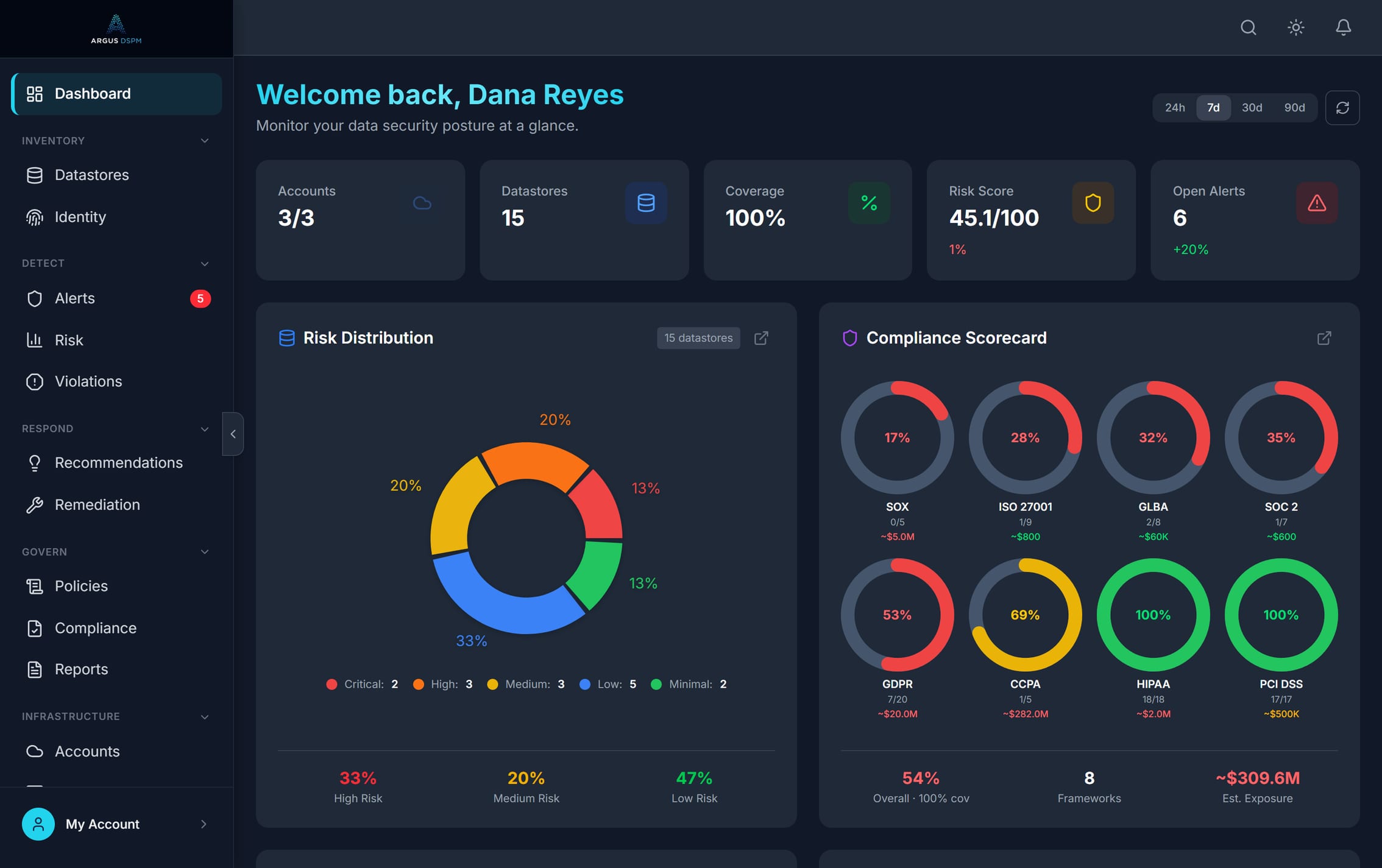
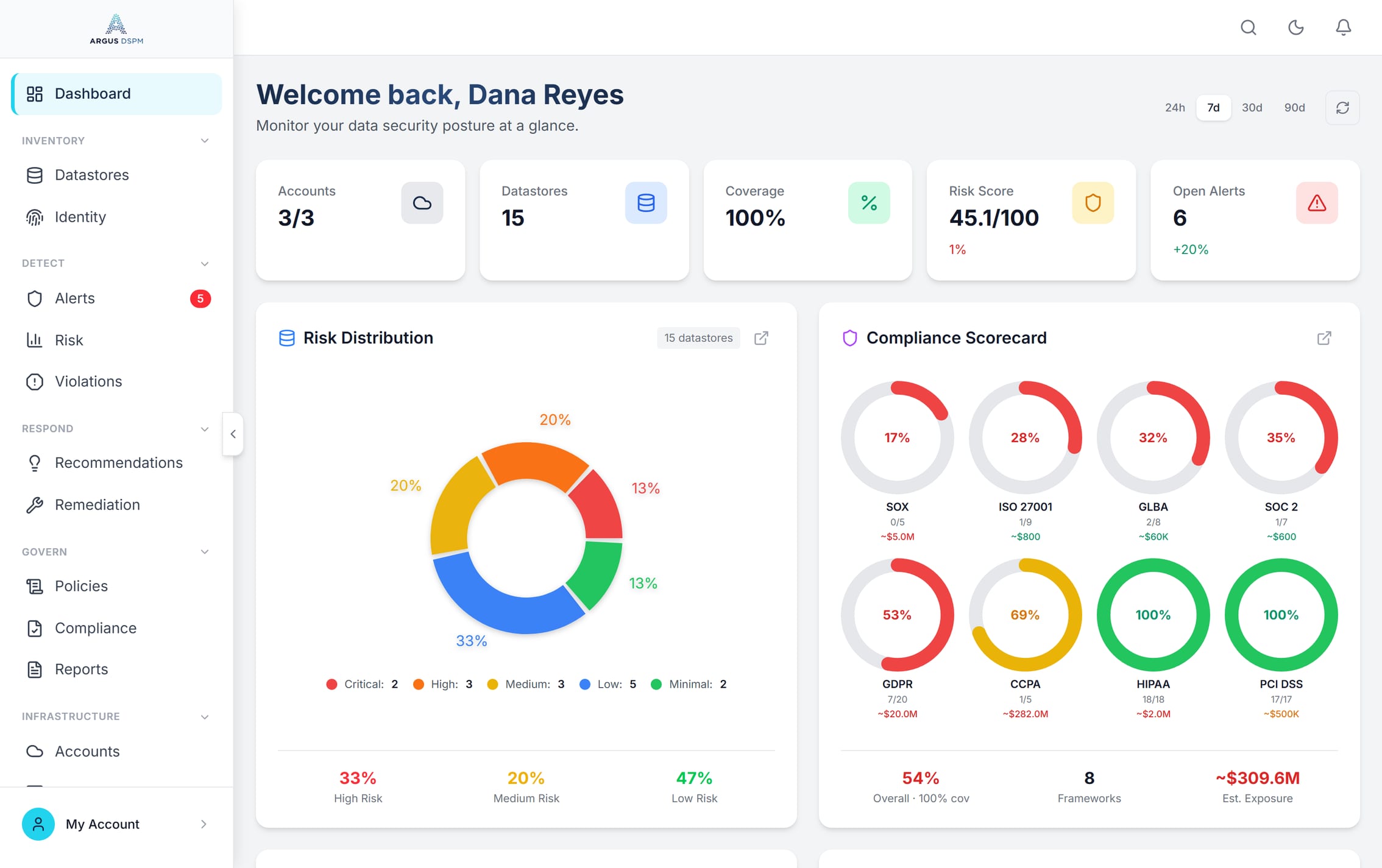
No data leaves your environment. No inbound ports opened. No sample sets uploaded to a third-party. Just structured findings - that you control.
A single deployment module drops the agent into your cloud environment. No firewall changes, no inbound ports, no shared credentials. It's running in minutes.
Argus finds every datastore - S3, RDS, DynamoDB, Redshift - and intelligently scans the files most likely to hold sensitive data. Less noise, faster results.
Every finding carries the fix. Approve it, watch it run, and let a verification rescan confirm it worked. If it didn't, roll it back in one click.
A split control-plane / data-plane design that satisfies the strictest data residency reviews. Customer data is processed inside the customer's VPC; only structured, non-reversible findings cross the boundary.
The agent makes outbound HTTPS calls only. Your perimeter stays closed - no firewall changes, no VPN, no public endpoint to defend.
Discovery and scanning are read-only. The narrow set of write permissions that automated remediation needs is a separate, opt-in grant you review and can revoke in one click - no static keys, no shared secrets.
Only structured findings - counts, categories, risk levels - cross the boundary. The sensitive data itself never leaves. Throttled scanning and automatic backoff keep it production-safe.
An inventory is only half the answer. Argus maps the datastores that hold sensitive data and the identities standing next to them, in the same pass.
S3, RDS, DynamoDB and Redshift discovered from a single agent, then scanned where sensitive data is most likely to live - so you get coverage without the noise.
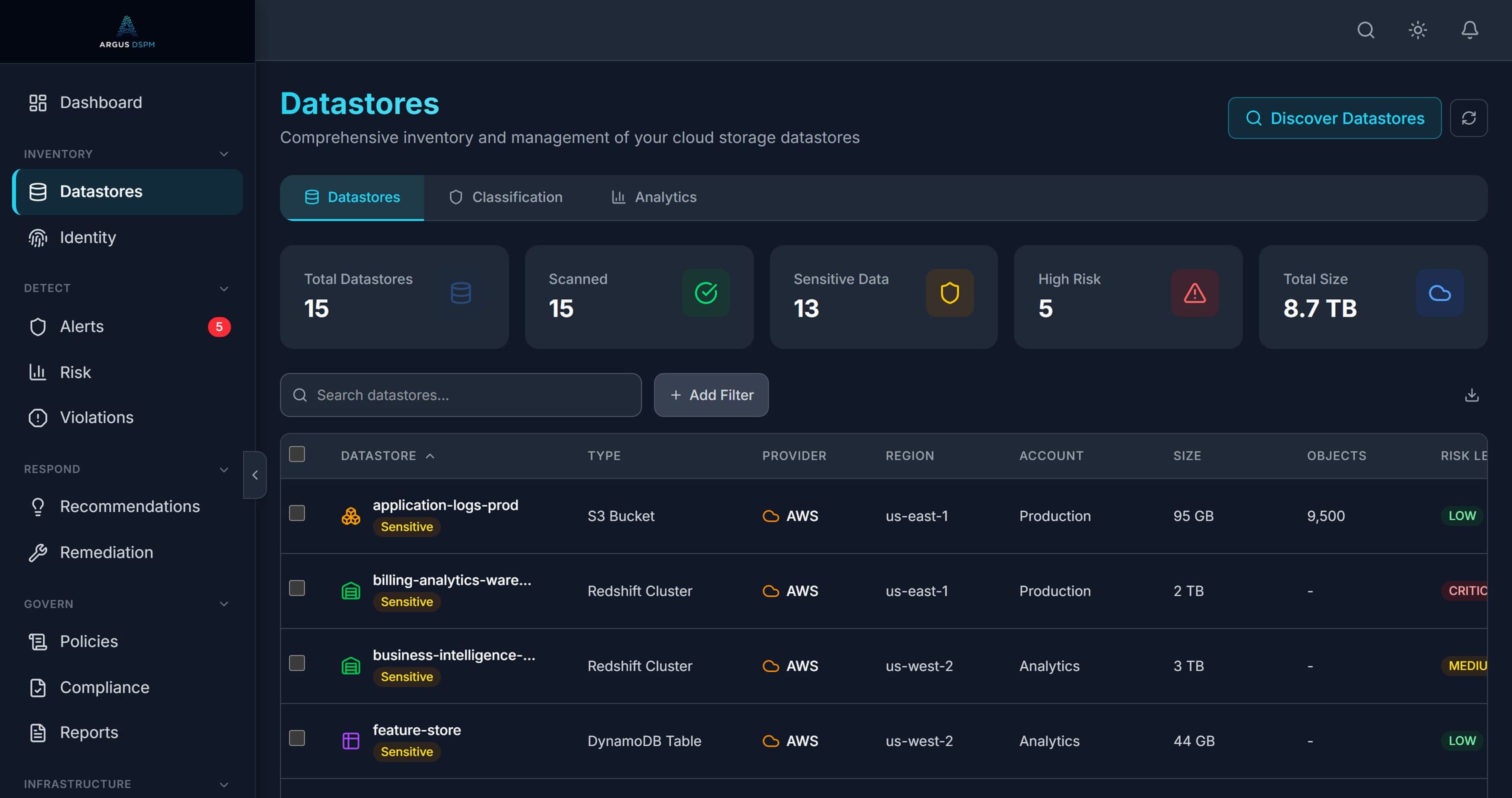
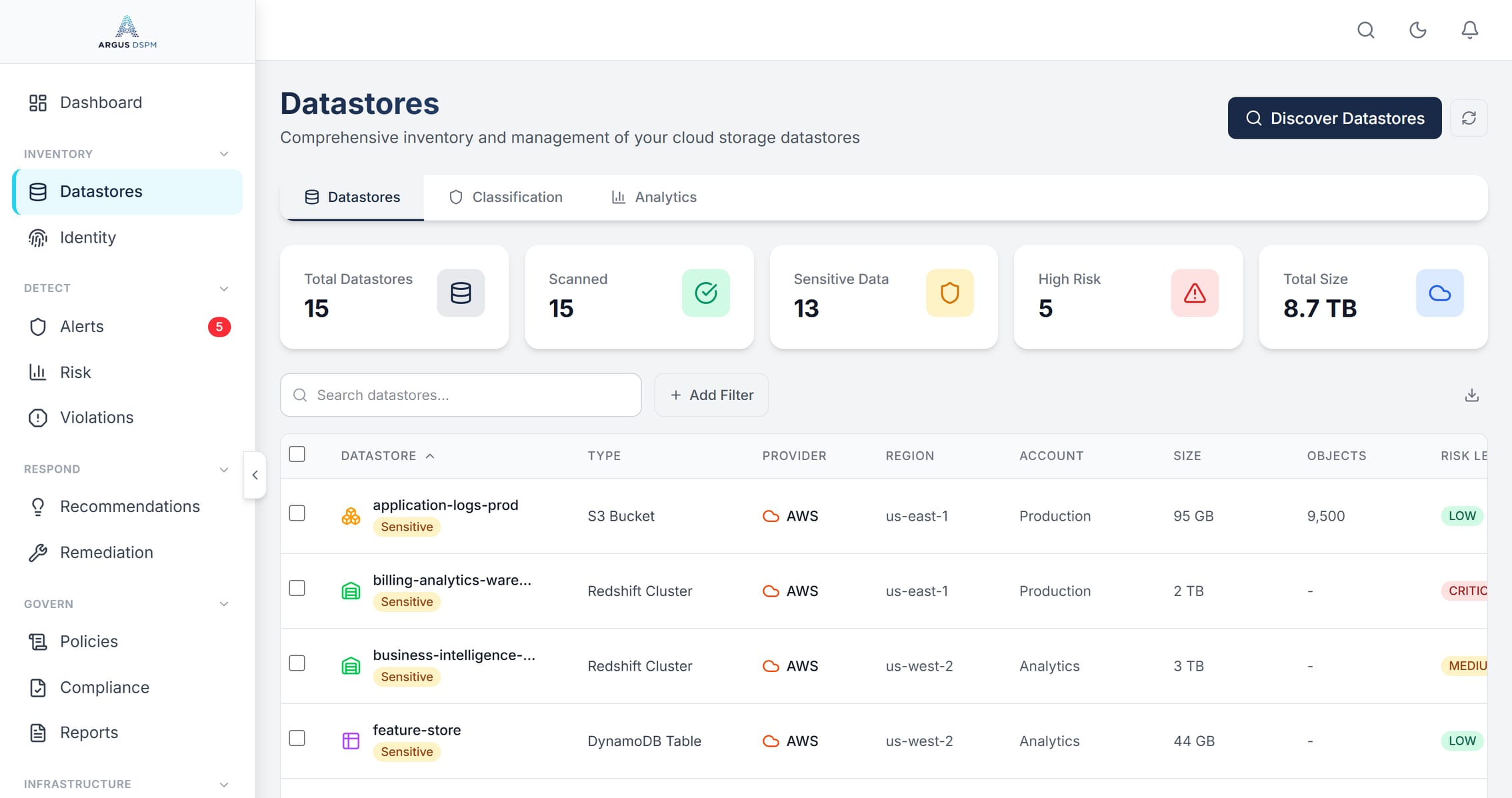
Argus reads your IAM graph alongside the data, so a bucket full of SSNs is never just a bucket - it is a bucket and the seven principals who can read it.
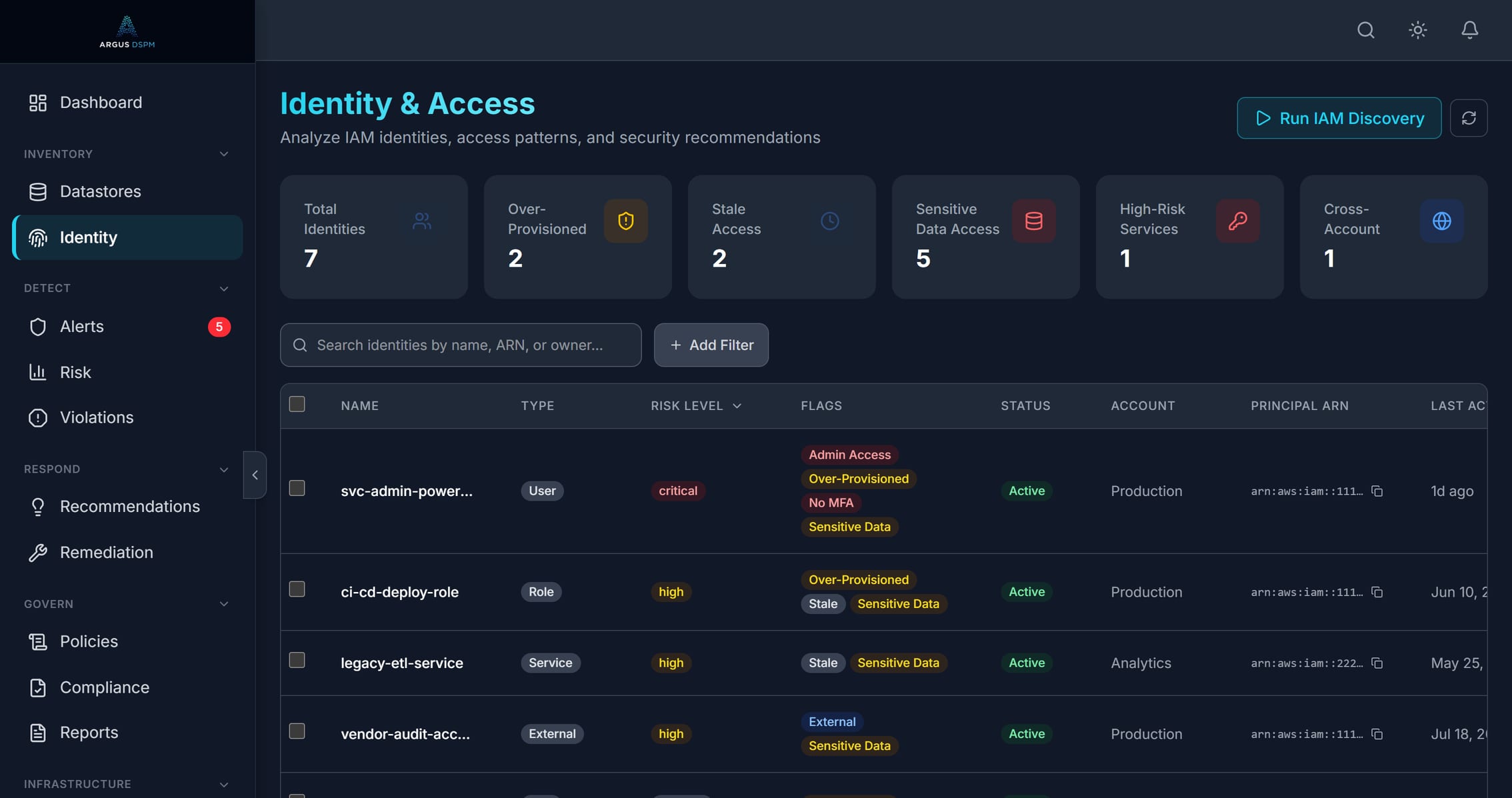
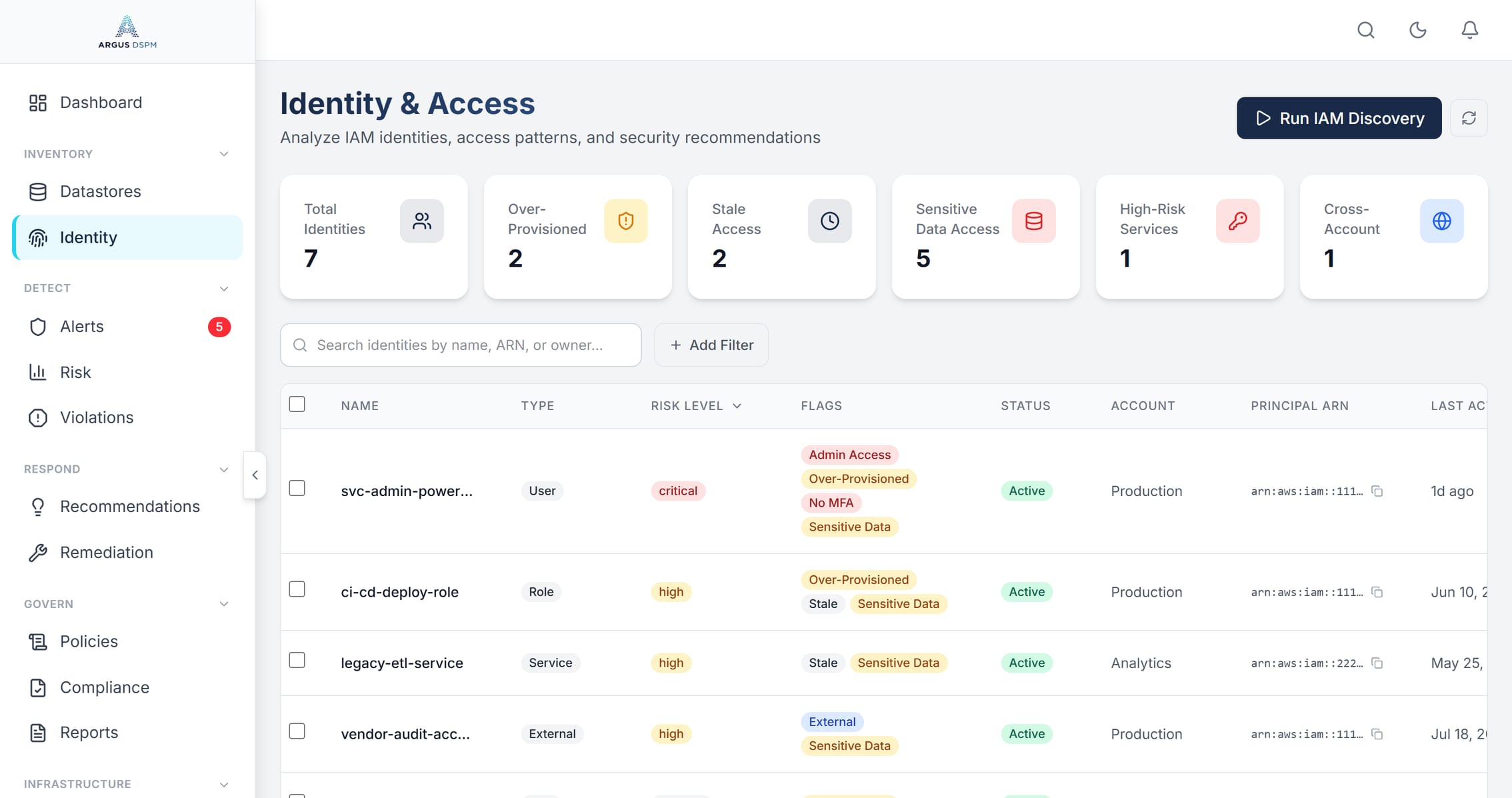
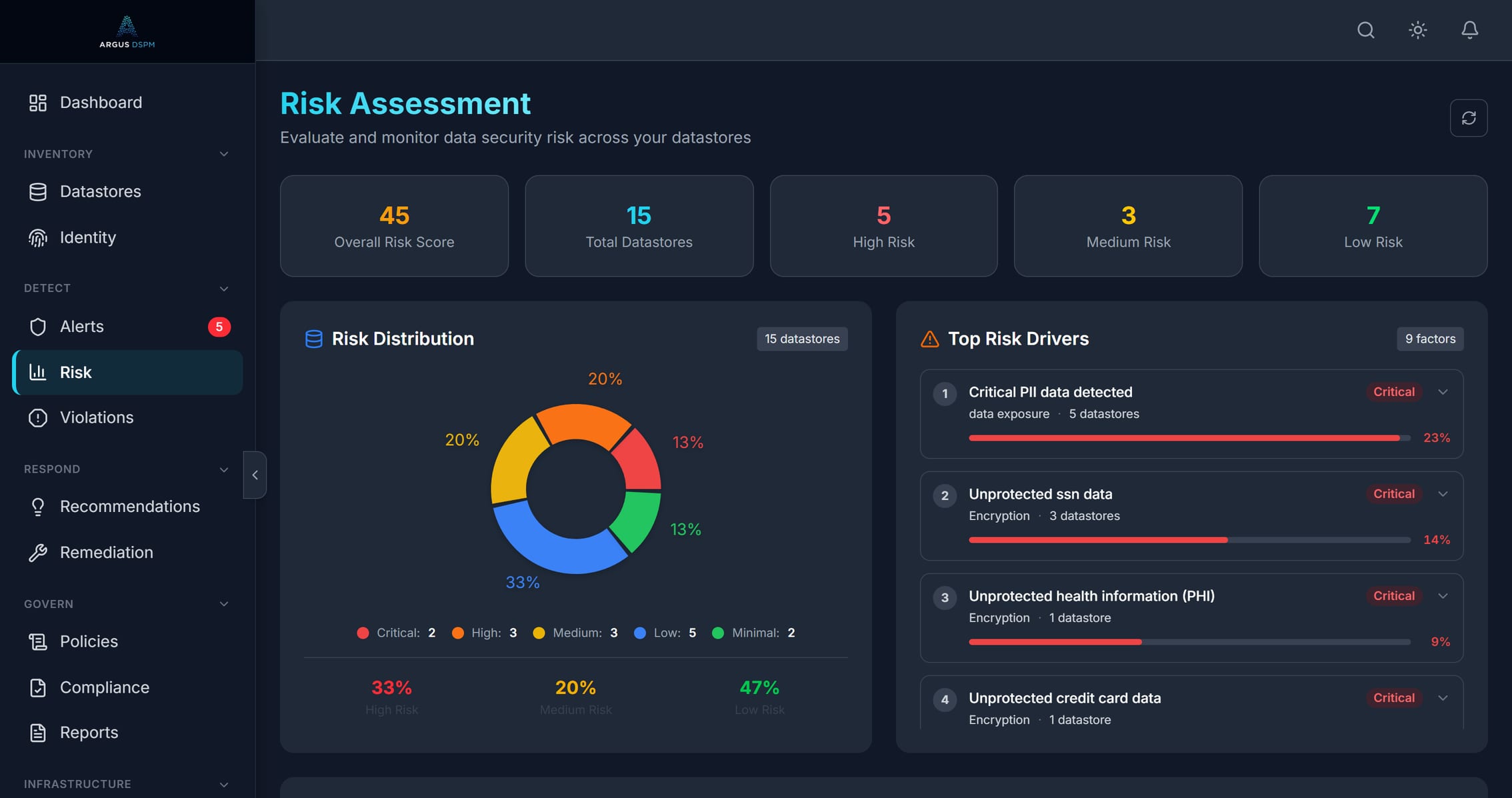
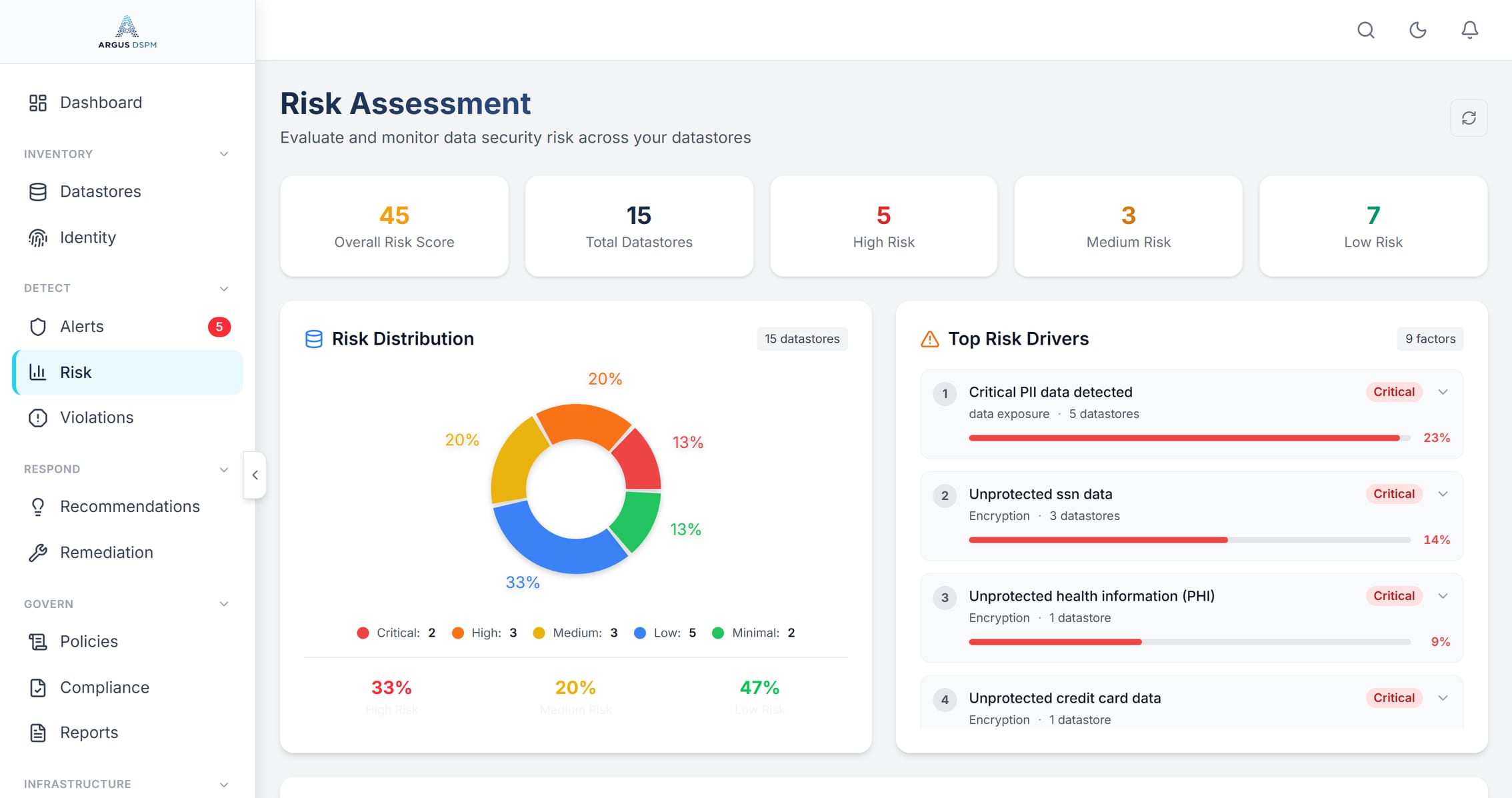
Argus scores what it finds on what the data is, how the store is configured and who can reach it - then puts the one thing that actually matters at the top.
Findings are deduplicated into alerts that carry severity, status and full attribution - which datastore, which account, which region, which data types.
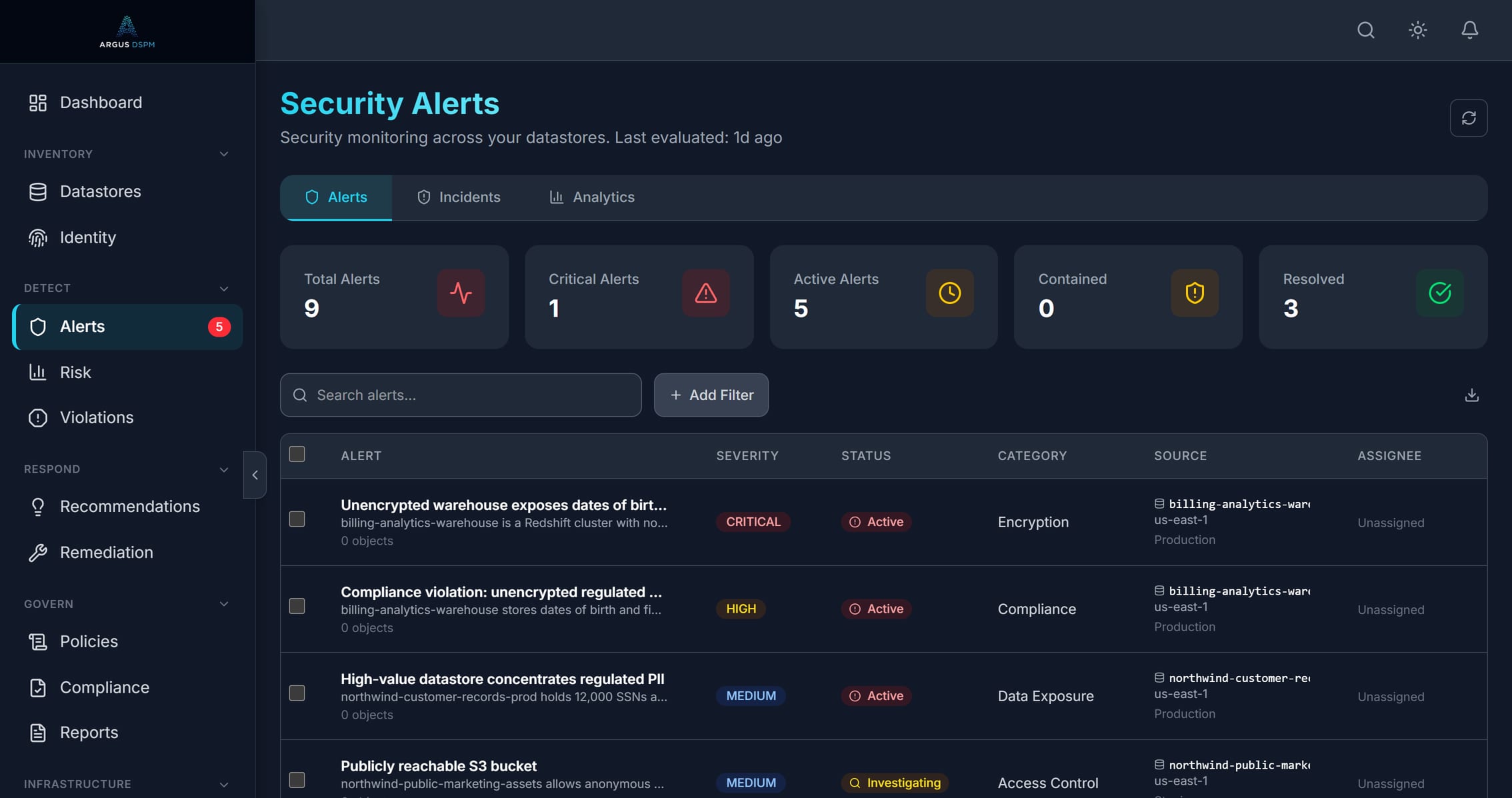
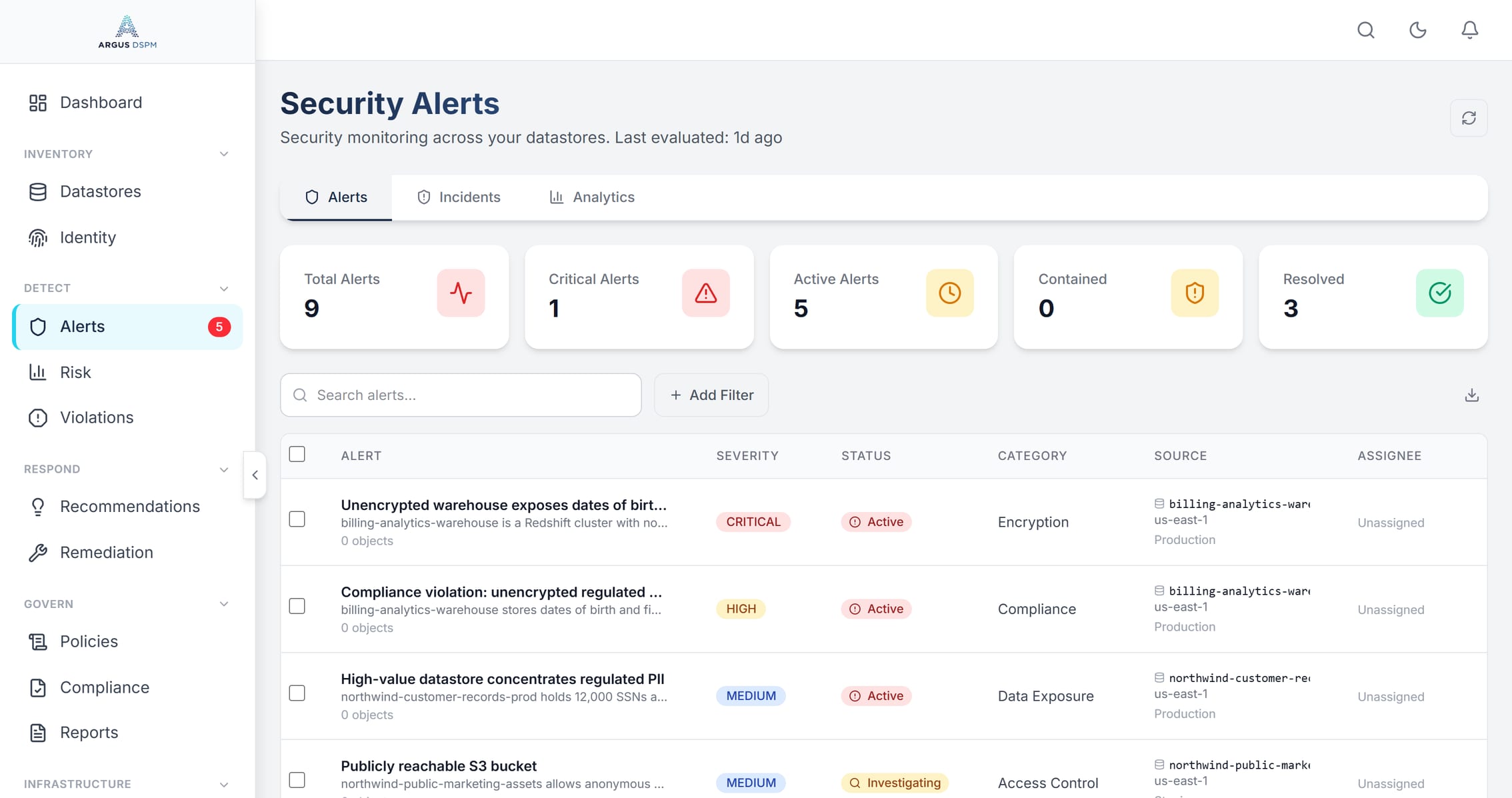
Every datastore and identity is scored, then ranked. Top risk drivers show what is pushing the number up, so the queue explains itself.
Write policies for what your organisation actually cares about - residency, retention, classification, encryption - and Argus raises a violation the moment a datastore drifts out of line.
Twelve findings on one bucket collapse into one prioritised fix, with the risk it removes and the effort it costs attached. No wall of tickets to triage by hand.
Confidence scores, sample sizes and the extrapolation behind every count are on the record - so a number in a board deck can be defended, not just quoted.
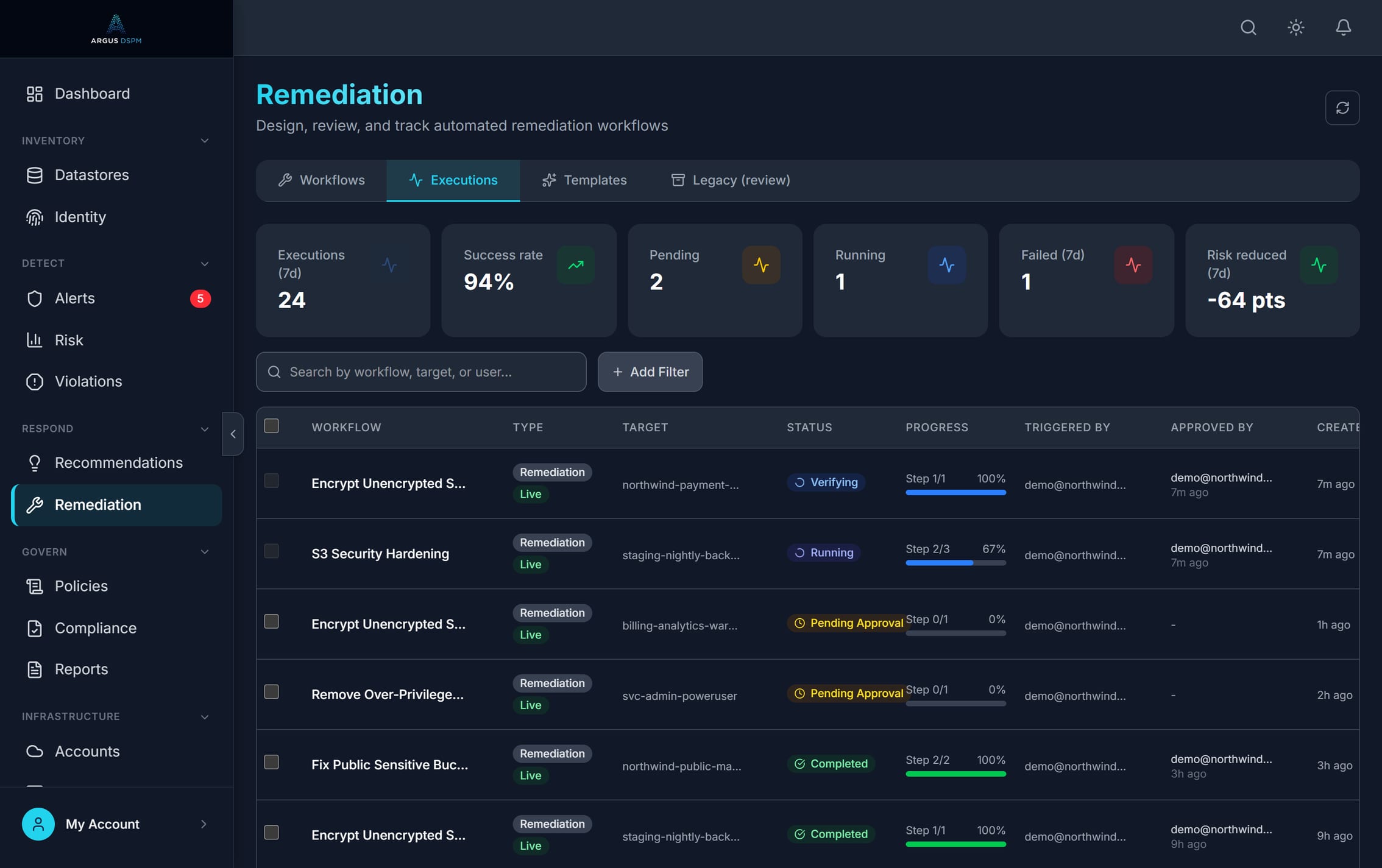
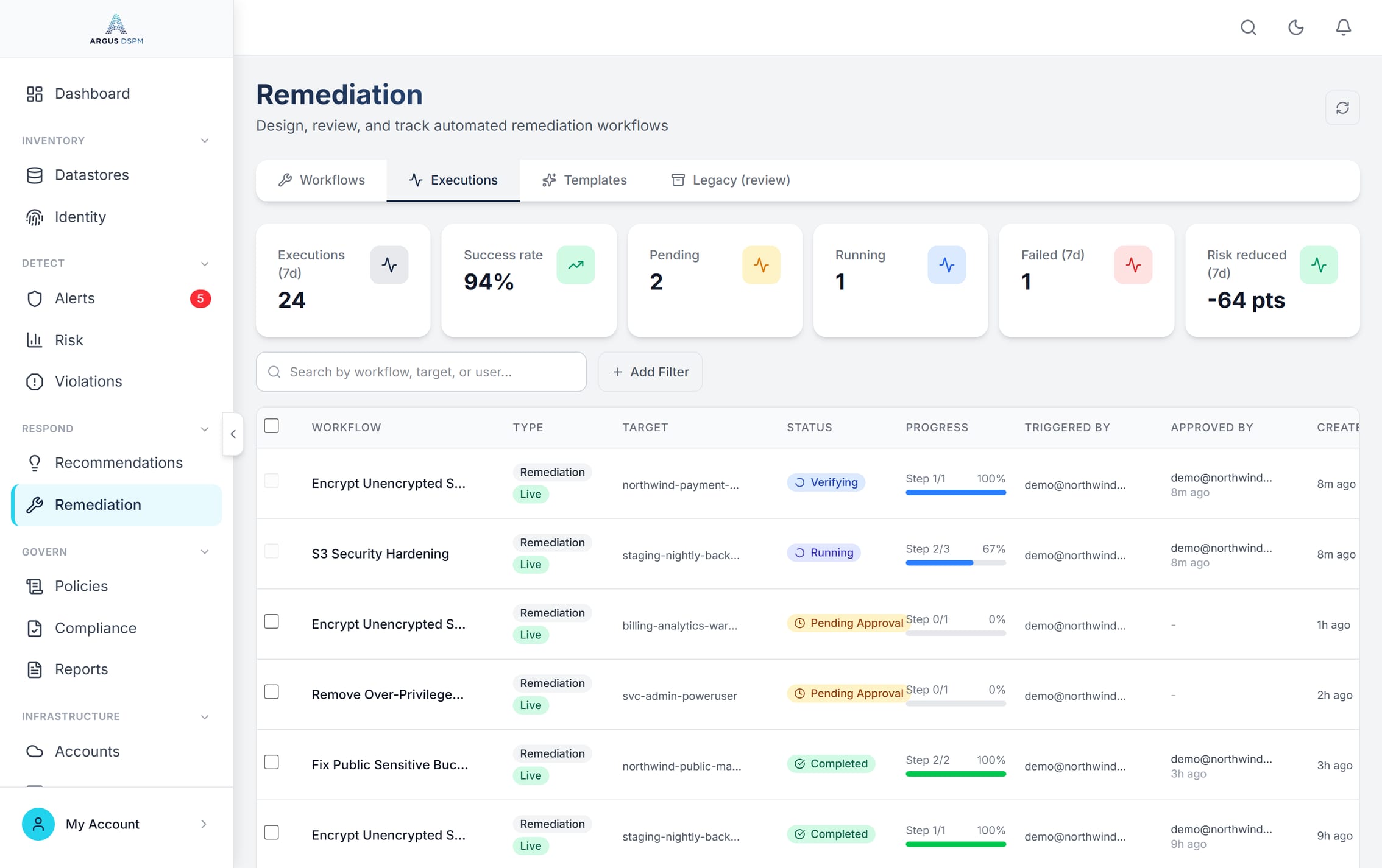
Build the fix once as a workflow. Argus dispatches it to the agent in your account, verifies it worked with a rescan, and keeps the door open to undo it.
Every workflow can run as a simulation that reports exactly what it would change, and changes nothing. See the diff before you own it.
Semi-automatic by default: the fix is queued, a named reviewer approves or rejects it, and the decision is on the audit trail. Fully automatic is opt-in, per workflow.
A run is not green when the API call returns. It goes to verifying, a rescan re-derives the posture, and only then does the finding close.
Argus snapshots the pre-execution state. If a fix breaks something downstream, roll it back in one click and the original state comes back.
Today Argus remediates S3 (block public access, default encryption, versioning, bucket policy) and IAM (disable access keys, detach over-privileged policies, enforce MFA). Everything runs through the agent already in your account, under the same read-plus-remediate role you signed off on.
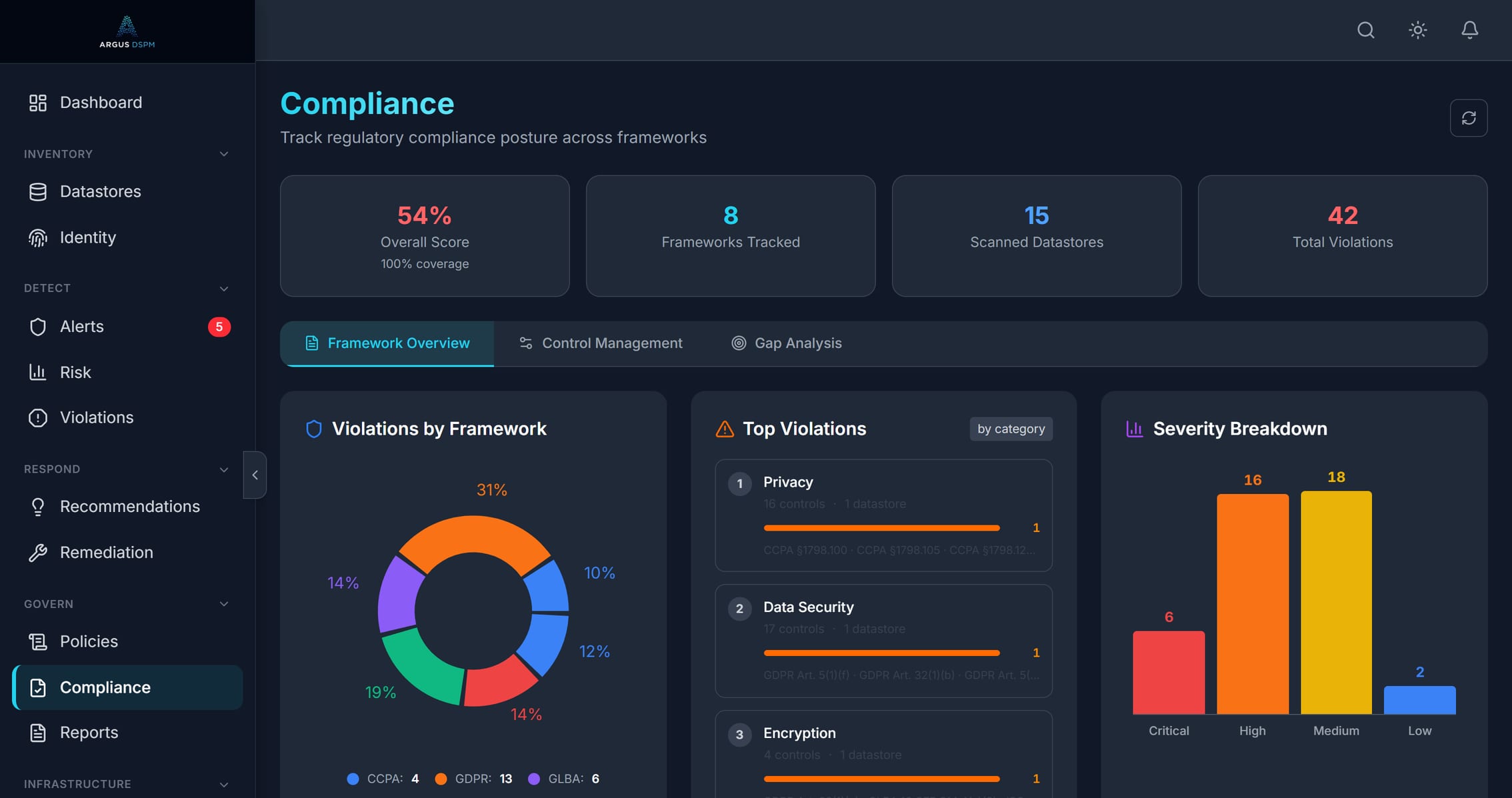
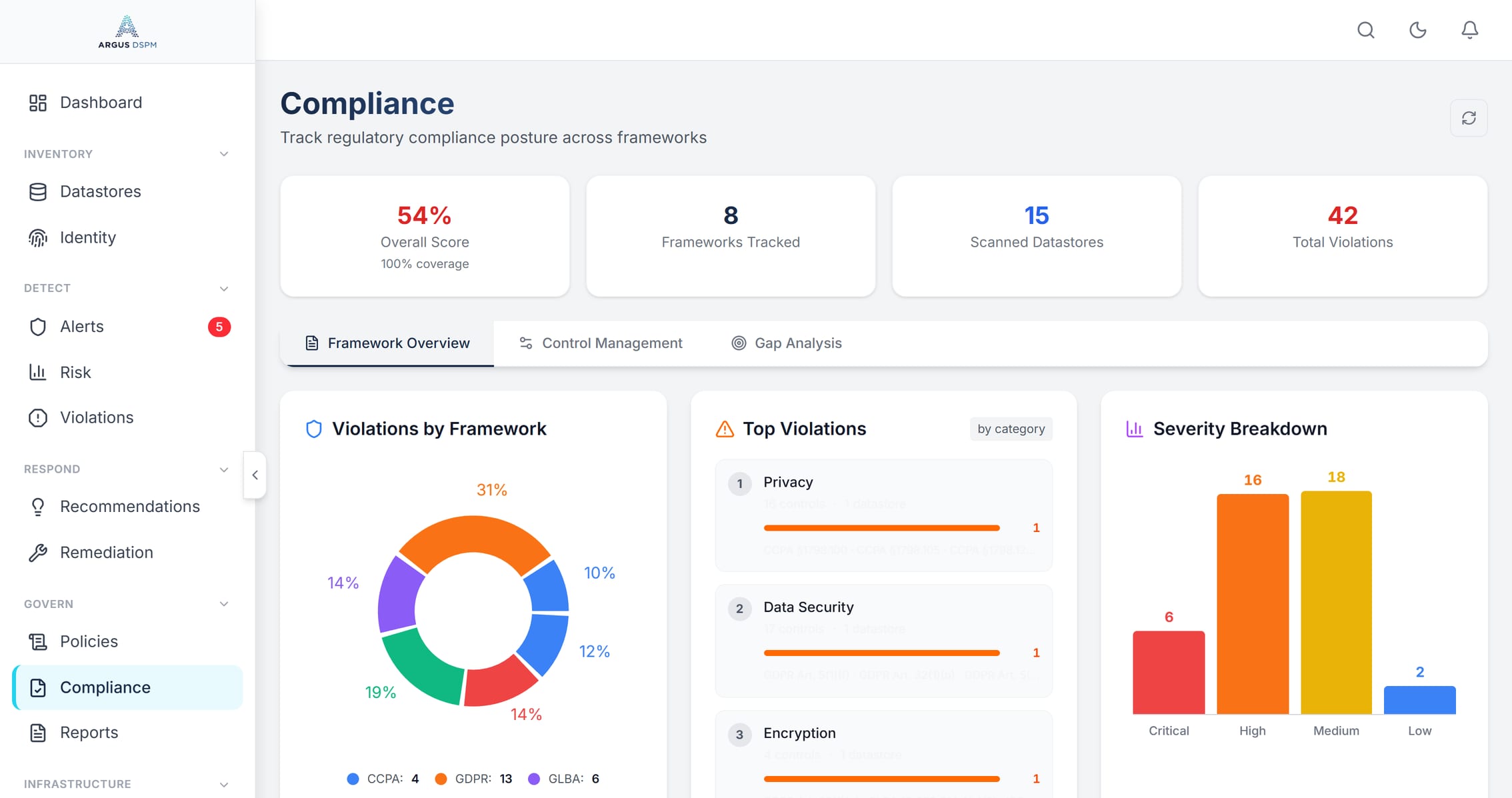
Findings tie to the controls they touch across eight frameworks, with the affected datastores and an estimated exposure attached - so an audit question has an answer, not a spreadsheet.
Every control is evaluated against what the agent actually observed. When a signal could not be read, Argus says so rather than guessing a pass.
Bring your identity provider. Sessions follow it.
Required on every account, not offered as a setting.
Per-section permissions, down to the individual action.
Every mutation recorded with actor, target and before-and-after values.
Credentials and findings encrypted; scan payloads never leave your VPC.
Every query is tenant-scoped. One customer can never read another's data.
Talk with us about your environment. We'll show you how Argus works, scope a pilot, and help you get visibility fast - without any sales-process drag.